
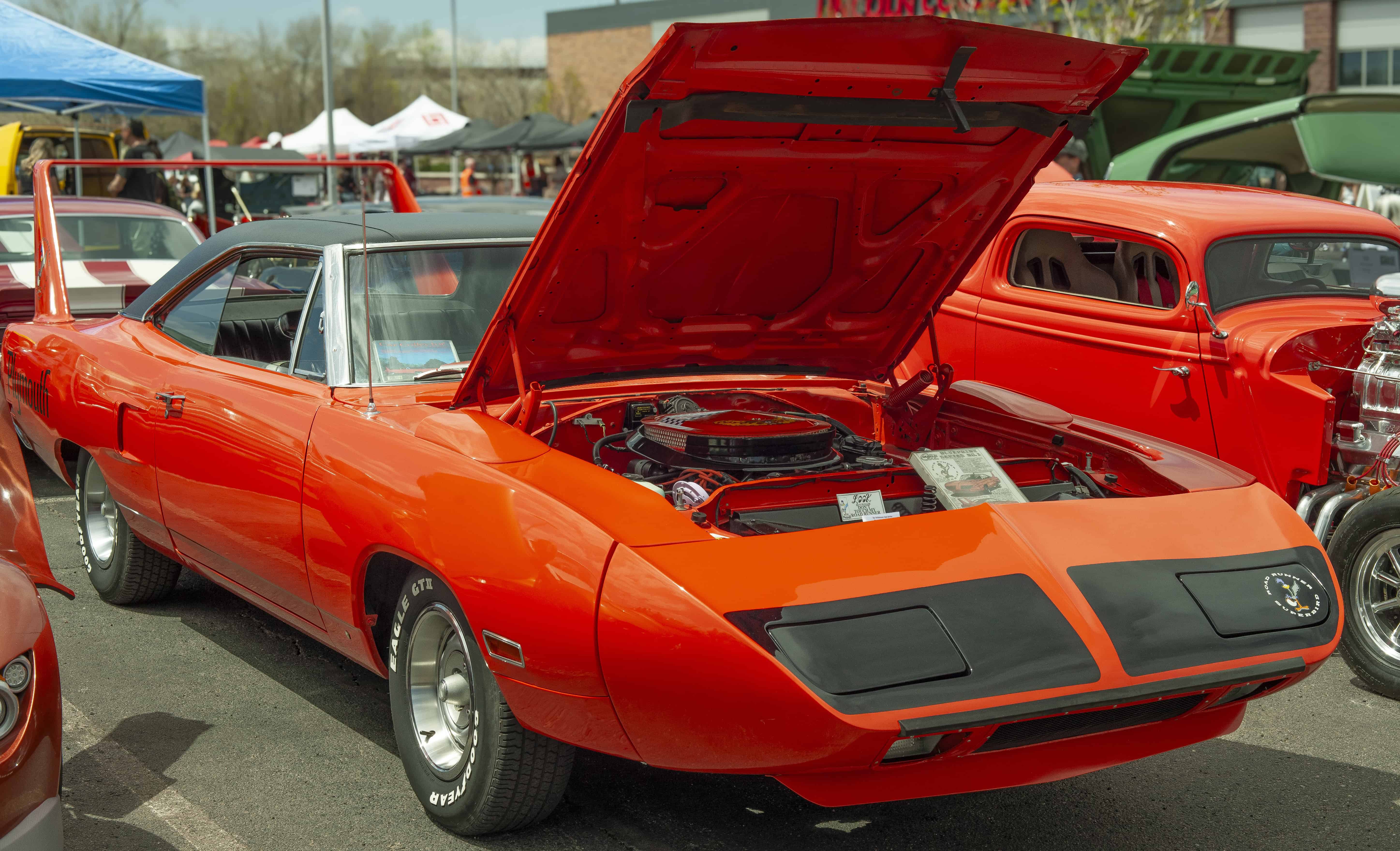
The Plymouth Superbird has the kind of shape that makes people stop halfway through a parking lot. The nose sticks out well past the front bumper, the rear wing looks tall enough to hang a jacket from, and a cartoon Road Runner rides on the side of the spoiler. None of that started as a styling exercise. Plymouth built the car because it needed a faster shape for NASCAR.
That is the easiest way to understand the Superbird. It was a race-car problem that ended up in Plymouth showrooms. NASCAR rules required manufacturers to sell road-going versions of the special bodies they wanted to race, so Plymouth couldn’t simply build a slippery stock car and send it to Daytona. It had to put Superbirds in the hands of ordinary buyers too.


The Road Runner Needed Help at High Speed
Plymouth already had the Road Runner, and it already had plenty of engine. The problem was what happened when the car had to push through the air on NASCAR’s fastest tracks. Dodge had attacked the same issue with the 1969 Charger Daytona, using a pointed nose and a huge rear wing to clean up the Charger’s aerodynamics. Plymouth followed with its own version for 1970.
The Superbird started with the Road Runner but changed the parts that mattered most in the wind. The blunt production-car front end gave way to an extended aerodynamic nose with hidden headlights. The rear window area was cleaned up, and the huge wing moved the rear aerodynamic load high into cleaner air. The result looked wild on the street because it had been shaped for a place where cars spent lap after lap running flat out.


Richard Petty Was Part of the Reason
There was another problem Plymouth wanted to solve. Richard Petty had left Plymouth and raced a Ford in 1969. Petty later made clear that the lack of a competitive Plymouth for the big tracks was a major reason for the move. When Plymouth had the Superbird ready for 1970, Petty came back.
The reunion did not take long to produce a win. NASCAR’s own race history records Petty’s victory at Rockingham on March 8, 1970, as his first win in the No. 43 Superbird after returning to Plymouth. Petty Enterprises also fielded a second Superbird for Pete Hamilton on the superspeedways. Hamilton won the 1970 Daytona 500 and both Talladega races that year.


The Street Car Still Had Plenty of Muscle
Plymouth didn’t send buyers home with a weak engine just because the bodywork was the main attraction. The standard Superbird used the 440 Super Commando four-barrel, factory-rated at 375 horsepower. Buyers could step up to the 440 Six Barrel, rated at 390 horsepower, or the 426 Hemi, rated at 425.
Those are period factory ratings, and the exact production breakdown of the different versions is one of the places where Superbird history gets messy. Published totals disagree. Even the overall number of street Superbirds is reported differently depending on the source. The safe description is that Plymouth built roughly 1,900 of them to satisfy NASCAR’s homologation requirement. Pretending there is one universally accepted production number would be tidier, but it wouldn’t be more accurate.


Under the Wing, It Was Still a Road Runner
The Superbird’s outside shape gets nearly all the attention, but climb inside and it looks much more familiar. This was still a Plymouth muscle car, not a stripped race car with plates hung on it. Depending on equipment, buyers could get the kind of buckets, gauges, console and four-speed hardware you would expect in a serious Mopar of the period.
The Hurst pistol-grip shifter is a good reminder of what the Superbird was underneath all that aero hardware. The street car had to live in traffic, idle at stoplights and make trips that had nothing to do with a racetrack. That ordinary side of the car is easy to forget because the outside is so completely unreasonable.


The Wing Wasn’t There for Decoration
There is a temptation to look at the Superbird now and treat the rear wing as a piece of 1970s excess. That misses the point. The entire aero package was there because Plymouth was chasing stability and speed on superspeedways. The Road Runner cartoon on the upright gave Plymouth a little fun with it, but the hardware itself came out of a serious racing program.
That is also why the Superbird makes more sense in motion than it does sitting under fluorescent lights. It was designed around conditions most street cars would never see. Put one next to a normal 1970 Road Runner and the amount of work Plymouth did to the body becomes obvious.

.jpg)
Then NASCAR Changed the Rules
The Superbird’s NASCAR window was short. For 1971, NASCAR restricted the special aerodynamic cars—including the Superbird and Charger Daytona—to a maximum engine size of 305 cubic inches. That was a huge step down from the big-block combinations the teams had been running.
It wasn’t technically a ban, but it did the job. The big-wing cars no longer made competitive sense in their original form, and Plymouth moved on. The Superbird was gone from the showroom after one model year too.
That short life is part of why the car still feels so strange. Most famous muscle cars evolved over several model years. The Superbird arrived looking completely unlike anything in the Plymouth showroom, did the job it had been created to do, and disappeared.
Why the Superbird Still Works
Plenty of cars are rare. Plenty are fast. The Superbird sticks because you can look at it and understand that somebody at Plymouth was willing to build an absurd-looking street car because the race car needed the same shape.
The nose, wing and Road Runner graphics make it instantly recognizable, but the story behind those pieces is better than the styling alone. Plymouth needed aerodynamic help. It wanted Richard Petty back. NASCAR required road cars before the race version could compete. Put those things together and you get a 1970 Road Runner that looks like it escaped from pit road.
That is why the Superbird still gets a crowd when one turns up at a car show. You don’t need to know the production total or the carburetor setup to notice it. But once you know why it looks that way, the car gets a lot more interesting.
Want to see cars like the Superbird in person? Find upcoming classic car shows, cruise-ins and Cars & Coffee events on CarCruiseFinder.com.