
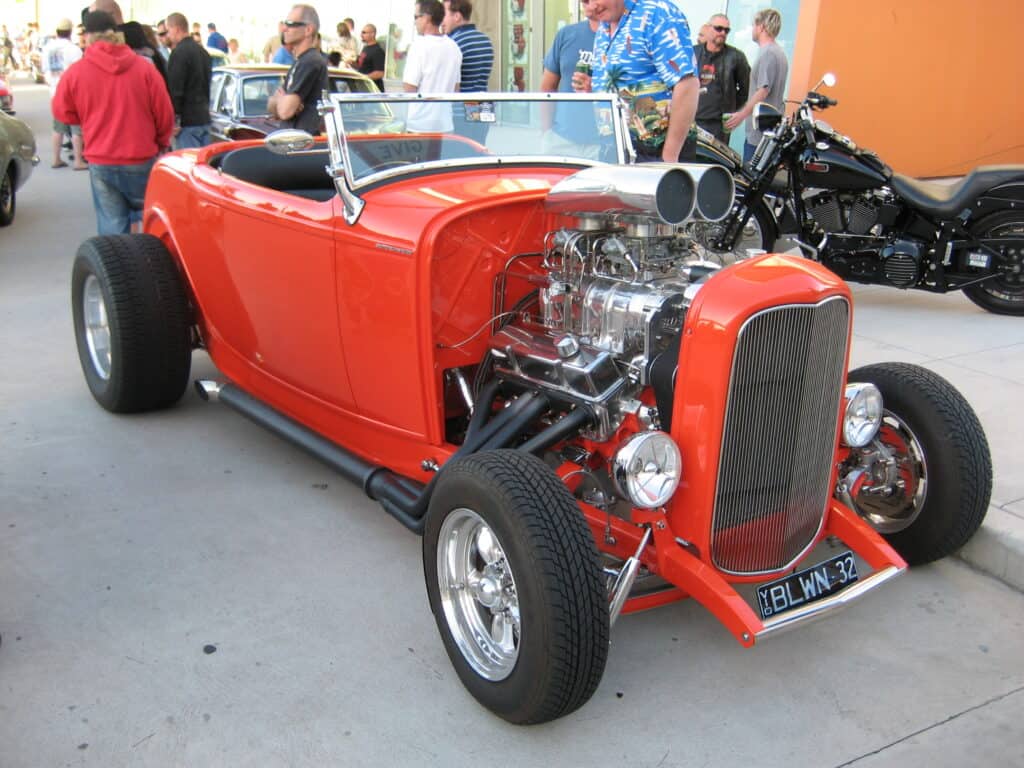
Spend enough time around hot rods and you start seeing the same year come up over and over: 1932. Roadsters, three-window coupes, five-window coupes, highboys, chopped cars, fenderless cars, flathead cars, small-block cars—it seems like the Deuce can take almost any direction and still look like a ’32 Ford.
That didn’t happen because the car was rare or exotic when it was new. It happened because Ford put a strong-looking body around an engine that changed what an inexpensive car could be, and then generations of hot rodders figured out just how much they could do with both of them.
First, One Name to Straighten Out
People often use “Model B” as a catch-all name for a 1932 Ford, especially once the conversation turns to hot rods. Ford’s actual 1932 lineup was a little more specific. The four-cylinder car was the Model B. The V-8 version was the Model 18.
The Henry Ford’s collection makes the distinction clearly: the Model B used a 201-cubic-inch four-cylinder rated at 50 horsepower, while its eight-cylinder contemporary was the Model 18. The two cars shared much of their basic look, which helps explain why the names get blurred together today. If somebody at a show calls a V-8 Deuce a Model B, you’ll know what they mean—but technically, the V-8 car started life as a Model 18.


The V-8 Changed the Deal
Ford wasn’t the first company to build a V-8. The important part was putting one into a car ordinary buyers could afford. The Henry Ford describes the new engine as the first V-8 light enough and inexpensive enough for a mass-produced vehicle. Its cylinder banks and crankcase were cast as one iron block, which was a major manufacturing achievement at the time.
The first version displaced 221 cubic inches and was rated at 65 horsepower. Those numbers sound mild now, but the point in 1932 wasn’t a dyno-sheet bragging contest. Ford had put eight-cylinder power into the low-price market, and the engine itself turned out to be unusually friendly to people who wanted to make it faster.
That last part is where the hot-rod story really starts. The Henry Ford notes that the flathead’s design lent itself to modification by backyard mechanics. As more engines reached junkyards and used-car lots, they became cheap, plentiful raw material. Speed equipment followed: manifolds, cylinder heads, camshafts, ignition parts, and all the other pieces that let a young builder make more power without needing a factory engineering department.
The Body Was Almost Asking to Be Modified
The engine gets most of the historical attention, but a hot rod still has to look right. The ’32 Ford had the proportions for it. The grille stood tall and narrow, the hood stretched back toward a compact body, and the roadster and coupe shapes were simple enough that removing a few pieces changed the whole attitude of the car.
The Henry Ford flat-out calls the 1932 roadster’s proportions a reason it became a hot-rod favorite. Their own preserved 1932 roadster was bought as an inexpensive used car and gradually rebuilt with parts from several makes. That was the basic hot-rod mindset: start with what you could get, take off what you didn’t need, and make the rest work better.

.jpg)
That flexibility is part of why the Deuce never settled into one single “correct” hot-rod look. Some builders kept full fenders. Some stripped them off. Some chopped coupe roofs. Some left roadster windshields tall, others cut them down. The body gave builders a recognizable starting point without boxing them into one style.
The Flathead Made Sense in a Garage
The original Ford V-8 mattered because regular people could actually work with it. The engine wasn’t just affordable when it was new; as the years passed, used flatheads became common enough that a whole performance industry grew around them. The Henry Ford’s transportation curator has described the American hot-rod hobby as being built around Ford’s flathead V-8, with speed shops offering performance manifolds, camshafts, and cylinder heads.
That doesn’t mean every 1932 Ford hot rod kept a flathead forever. Far from it. The same basic culture that encouraged people to modify the Ford engine also encouraged them to swap in whatever made sense later. Small-block Chevrolets, early Hemis, and plenty of other engines found their way between Deuce frame rails.

.jpg)
Engine Swaps Were Part of the Story, Too
One of the best surviving examples is in The Henry Ford’s collection. Dick Smith bought a 1932 Ford roadster in 1949 and kept changing it. Between 1954 and 1963, he installed a 1951 Chrysler V-8 along with a Packard transmission and other parts from Studebaker, Chevrolet, Ford, and Dodge. That car is a useful reminder that traditional hot rodding was never about preserving a parts catalog exactly as printed.
It was about building the car you wanted with the parts you could get. A ’32 Ford body might be the common thread, but what happened underneath it depended on the builder, the budget, and what was sitting in the garage.
Then the Deuce Escaped the Garage
By the early 1960s, the 1932 Ford had become recognizable well outside the circle of people actually building hot rods. The Beach Boys helped push that image into the mainstream with “Little Deuce Coupe,” and NHRA notes that the album cover used a Hot Rod magazine photo of Clarence “Chili” Catallo’s customized 1932 Ford coupe.
That is about as strong a sign of cultural crossover as a car can get. The Deuce had gone from inexpensive transportation, to used hot-rod material, to a symbol that could carry an album title and still make sense to people who had never owned a set of speed wrenches.

.jpg)
Why the 1932 Ford Still Looks Right
There are faster cars, rarer cars, and cars with more complicated engineering stories. The Deuce stuck because several things lined up at once. It arrived with an engine that made V-8 power available to a much wider group of buyers. Its body had clean proportions that survived heavy modification. Then enough old examples and engines circulated through the hobby that builders could keep experimenting with them.
That history also explains why two 1932 Ford hot rods can look nothing alike and both still feel legitimate. One can run a flathead and skinny tires with a stripped-down traditional look. Another can wear modern suspension, a later V-8, and paint that would have been impossible in 1932. The common thread is the shape underneath it all.
Nearly a century after Ford introduced the car, you can still walk through a show field and spot a Deuce from several rows away. That isn’t nostalgia doing all the work. The car earned its place by being useful to builders first, and iconic afterward.
The Bottom Line
The 1932 Ford did not become America’s default hot-rod shape because somebody decided it should be collectible. It became important because people could afford it, modify it, race it, swap engines into it, cut pieces off it, and make it their own. The fact that it also happened to look good after all that was the lucky part.
If you want to see how that tradition keeps changing in the real world, browse upcoming car shows and cruise-ins on CarCruiseFinder.com. There is a good chance a Deuce—or something built in its image—will be sitting somewhere in the field.
