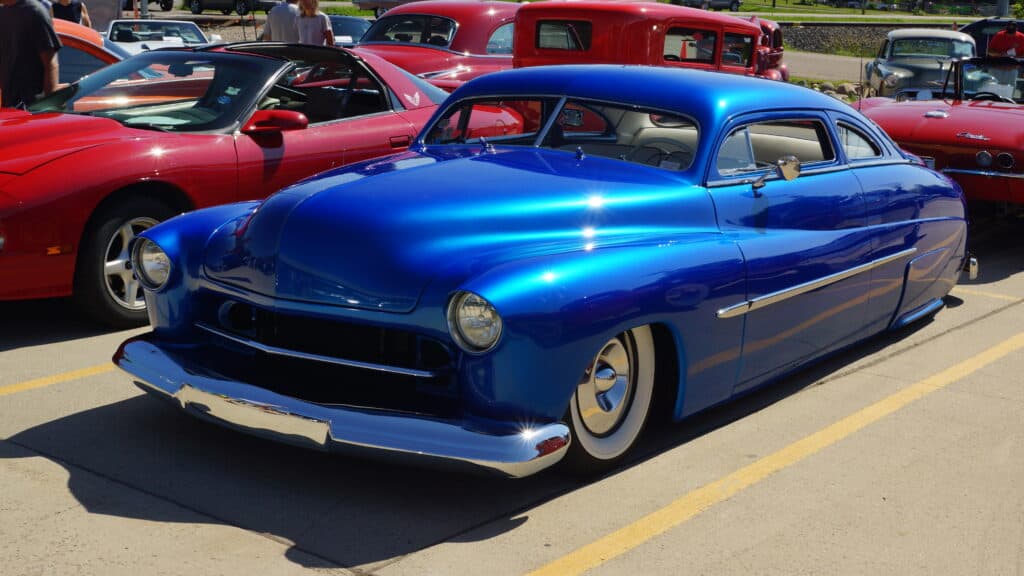
There’s a reason a chopped Mercury can pull a crowd even when it’s parked next to cars with twice the horsepower. The roof looks lower than it ought to, the body seems to stretch from bumper to bumper, and the trim that once broke up all that sheet metal has mostly disappeared. You recognize the shape immediately, but you may have to look twice to see where the original Mercury ends and the custom work begins.
That look grew out of the 1949–1951 Mercurys. They weren’t built as hot rods or specialty cars. They were regular production automobiles that happened to give custom builders an unusually good starting point.
The Mercury before the cutting began
Mercury’s redesigned 1949 body had rounded fenders, fairly small window openings and a long, full-sided profile. Even in factory trim, it looked substantial. The body carried its curves well without needing a lot of added ornament. Those proportions mattered to the people who began cutting into them.
These were not factory lead sleds. A showroom Mercury was a practical passenger car with its original roof height, lights, bumpers and brightwork. It came from the Lincoln-Mercury division, not from a California custom shop. One look at a relatively stock coupe makes the later changes easier to understand: the customizer was working with an already rounded shape, not trying to create one from a squared-off body.

A lower roof changed everything
On many traditional Mercury customs, the roof chop is the first thing you notice. To chop a top, a builder cuts down the roof structure and reworks the pillars and window openings so the roof can sit lower. Doing it well is much more involved than removing the same amount of metal from every post. The front and rear glass, door frames and roof contours all have to make sense together.
With less glass above the beltline, the heavy lower body appears longer and flatter. Lowering the suspension reinforces that impression. A full-bodied Mercury that once sat like a normal family car starts to look as though it’s moving even at rest. Not every custom Merc has the same chop, and some keep an uncut roof; the effect depends on the builder’s choices.

What the builders took away
The other big change came from cleaning up the body. Builders could remove trim, smooth seams, reshape grilles and bumpers, and move the headlights inward so their rims blended into the surrounding metal. That recessed treatment is commonly called frenching. Similar work could be done around the taillights. A more restrained custom might keep much of the original character; a more ambitious one could make the front and rear ends look nearly hand-built.
Those changes worked together. Take away a bright molding, and the side of the car reads as one long surface. French the lights, and the nose looks less like a collection of bolt-on pieces. A well-done Mercury custom usually isn’t about one spectacular modification. It’s about several changes that make the original shape seem more deliberate.
The phrase lead sled comes from traditional bodyworking practices, including the use of lead-based filler to smooth seams and reshaped panels. The Henry Ford uses the term in describing how Mercurys were lowered and their seams were filled with lead. It’s a name for a style as much as a guarantee of what materials are inside a particular car today. Modern customs may use different fillers and fabrication methods.

Sam Barris and the early custom Mercury
Sam Barris’s own 1949 Mercury is a major part of the story. Barris Kustom’s account describes him buying a new Mercury, then chopping it and revising the headlights, fender lines and roof drip moldings. His work helped demonstrate what the car could become when its factory roof and trim were no longer treated as fixed boundaries.
George and Sam Barris are closely associated with the Southern California custom scene, but it would be wrong to give them credit for every idea seen on a chopped Mercury. Customizing was a working culture of shops, individual builders, painters, upholsterers and owners, each borrowing and refining techniques. What the Barris name does give us is a particularly well-documented example of that period’s approach.
The Henry Ford preserves a 1949 Mercury convertible modified by Barris Kustom Industries, with a padded removable top made by Carson Top Shop. It has a shortened windshield, frenched lights and smoothed bodywork. The museum also documents later changes to the car. Its metalflake paint and scallops were added in the 1960s, and the grille now on it came from a 1957 Corvette. Those details are part of the car’s history, but they shouldn’t all be dated to its first round of customization.

Paint, trim and the finishing touches
Dark, deep-looking paint can make the Mercury’s long curves stand out. So can carefully placed pinstriping, scallops and contrasting upholstery. The choice depends on the build. Some customs are deliberately quiet, with little chrome and few flourishes; others make a show of the painter’s and pinstriper’s work.
Small details count on a body this broad. Wheel covers, fender skirts, a revised grille, taillight treatment and the fit of the hood can all change how finished the car looks. Some of these touches were familiar to period custom builders, while others on cars photographed today are modern interpretations. An old-style paint job on a car with contemporary running gear doesn’t make every component a 1950s part.

Period custom, restoration or restomod?
At a show today, two Mercurys can look nearly identical from the sidewalk and be very different underneath. One may retain a flathead V8 and much of its period chassis. Another may have modern suspension, disc brakes, a later engine and updated air conditioning. A third might be a careful restoration of a custom built decades ago. All can be interesting cars, but they tell different stories.
That’s why labels matter. Factory equipment is what Mercury supplied when the car was new. Period custom work means changes actually made in the era being discussed, ideally documented by photographs or shop records. A traditional-style custom built much later can follow the same visual rules without being an original period build. A restomod can preserve the recognizable body while changing major mechanical systems. The car in front of you may combine several of those categories.
Why the shape still works
The 1949–1951 Mercury gave builders room to work. Its fenders, roof and body sides made it possible to change the car dramatically without losing its basic identity. You can see the factory coupe in a finished lead sled, but you can also see the hours spent cutting, welding, aligning and finishing it.
There’s no single correct Mercury custom. The best ones make you notice the overall proportions before you start picking out individual changes. Then you get closer and see what somebody actually did: the reshaped window frame, the light tucked into the fender, the trim hole that’s no longer there. That’s the appeal of the lead sled. It rewards a second look.