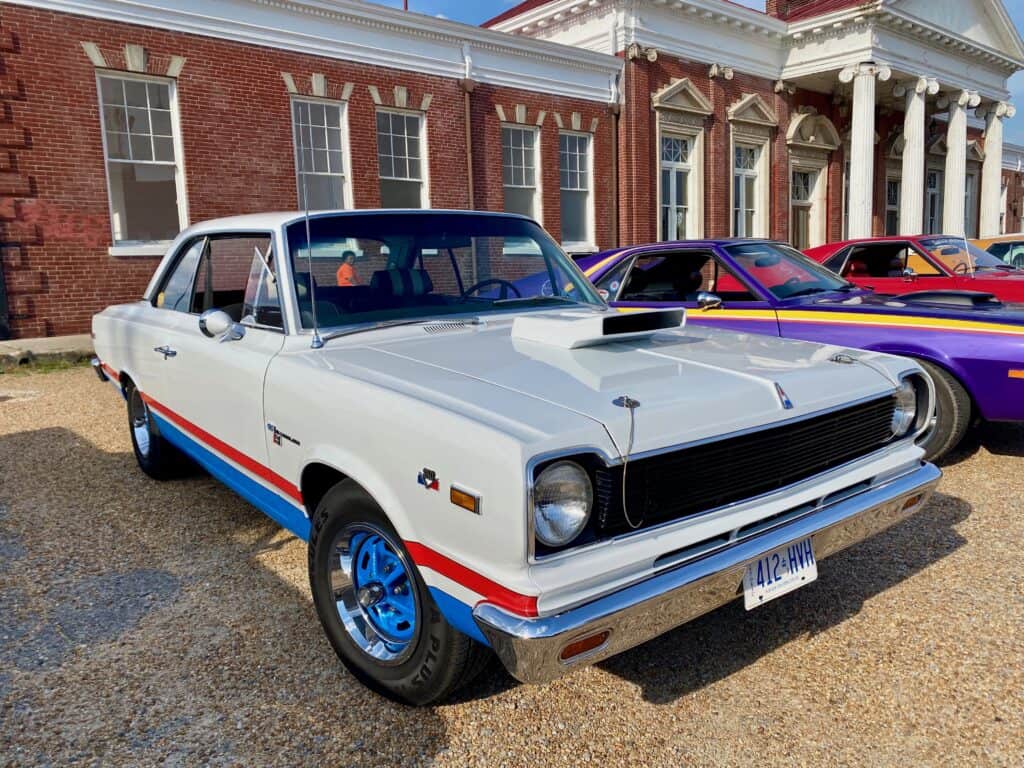
AMC wasn’t interested in being subtle when it rolled out the SC/Rambler in 1969. The hood said “390 CU. IN.” in giant letters. A boxy air scoop carried the word “AIR.” And depending on which paint scheme you ordered, the sides of the car could look as if somebody had unfurled a red, white and blue flag across a compact Rambler hardtop.
Underneath those graphics was a serious factory package. American Motors and Hurst Performance paired the Rambler’s relatively small body with AMC’s 390-cubic-inch V8, a four-speed manual gearbox, a limited-slip rear axle and equipment meant to make the car useful at the drag strip. It wasn’t a backyard swap or a dealer’s one-off. AMC built and sold it as the SC/Rambler, a 1969-only performance model.

A compact Rambler with a different job
By the late 1960s, AMC had performance cars in the AMX and Javelin, but the company also had a much smaller Rambler hardtop in its lineup. For the SC/Rambler, AMC and Hurst used that compact platform as the starting point for a deliberately conspicuous, drag-strip-minded model. The result shared its basic body with the Rambler Rogue hardtop but wasn’t equipped like an ordinary Rogue.
That distinction matters today. A stock-looking Rambler with a transplanted 390 isn’t automatically an SC/Rambler, and the factory car wasn’t just a paint-and-decals edition. The drivetrain, axle, braking and suspension equipment were part of what made the package special.
The 390 was the point
AMC installed its 390-cubic-inch V8, advertised at 315 horsepower and 425 lb-ft of torque under the horsepower-rating conventions of the day. A four-barrel carburetor supplied the fuel. Every SC/Rambler came with a four-speed manual transmission and a Hurst shifter; there wasn’t an automatic-transmission version of the factory package.
Power went to a 3.54:1 Twin-Grip limited-slip rear axle. Front power disc brakes, heavy-duty suspension pieces and other performance-oriented hardware were part of the car’s specification. The approach was straightforward: start with a light, compact body by American-car standards, give it a big V8, and fit equipment that could put the power to work.
Those 315 horses are a period factory rating, not a modern SAE net figure. A current car advertised at 315 hp is measured differently, so a head-to-head paper comparison doesn’t say much about what either one would do on the road.
That hood scoop wasn’t for decoration
The rectangular scoop looked almost comically tall against the Rambler’s otherwise plain hood. But there was a reason for it. The factory induction setup directed outside air toward the engine’s air cleaner through a controlled inlet. The painted arrow and “AIR” lettering told everyone what AMC wanted them to notice, but the hardware below the scoop made it more than a styling trick.
As with plenty of muscle cars, it’s worth checking what is actually under the hood of a survivor. An aftermarket air cleaner, replacement induction parts or an altered engine can make a restored or modified SC/Rambler look different from a factory-delivered example.

Two paint schemes, neither easily mistaken for a taxi
AMC offered two red, white and blue treatments. The better-known A-scheme had broad red sections down the body sides and blue graphics across the top of the white car. The B-scheme kept the predominantly white body and moved the red and blue emphasis to narrower stripes low along the sides. Both retained the SC/Rambler’s unmistakable hood markings.
The B-scheme looks restrained only when parked next to an A-scheme car. Either one would have stood out in a 1969 supermarket parking lot. Today the difference is useful for understanding the model’s history, but paint alone isn’t proof of originality. Restorations, repaints and recreations need to be judged against their documentation.

A practical cabin with a race-car clue
Open the door and the SC/Rambler makes a different impression. Instead of a lavish custom interior, there was charcoal-colored trim, reclining front seating and red, white and blue headrest upholstery. The Sun tachometer attached to the steering column was one of the more obvious signs that this was no ordinary economy Rambler.
The Hurst floor shifter was another. For all the noise the exterior made, the cabin kept much of the compact Rambler’s straightforward character. It was a production car a buyer could drive away from an AMC dealer, not a stripped-out purpose-built race shell.

Built with the drag strip in mind
The SC/Rambler’s combination of engine, gearing, transmission and limited-slip differential was aimed at buyers who cared about quarter-mile times. Contemporary magazine tests give a sense of the car’s pace, but a single road-test result should never be presented as a guarantee of what every stock SC/Rambler could run. Tires, preparation, weather and the individual test car all mattered.
AMC also offered performance parts through its broader parts program, and many SC/Ramblers went on to receive racing modifications. Those upgrades belong in the car’s history, but they shouldn’t be folded into a description of how a standard example left the assembly line. The same goes for present-day restorations with modified engines, tires or suspension setups.
A short run—and a long argument about the paint mix
The accepted total is 1,512 SC/Ramblers built for 1969. That makes it a relatively uncommon factory performance car, especially compared with the better-known muscle models from the Detroit Three.
The split between the A-scheme and B-scheme is much less settled. Published histories disagree on the exact quantities, and stories about the sequence in which AMC painted the cars don’t all line up with those figures. Rather than pretend a disputed breakdown is a factory-certified number, it’s more useful to say that both schemes were production offerings and that the A-scheme is generally reported as the more common one.
Why the SC/Rambler still gets attention
It’s tempting to treat the SC/Rambler as a funny paint job attached to a big engine. That misses the appeal. AMC and Hurst assembled a real factory performance package around a compact body that most people associated with practical transportation. It had the hardware to back up at least some of its visual bravado.
There’s also something refreshingly direct about it. No mystery about the engine size. No attempt to disguise its intentions. The SC/Rambler was built to get noticed on the street, and then to be taken seriously when it pulled up to the starting line. Nearly six decades later, that combination still works at a car show.